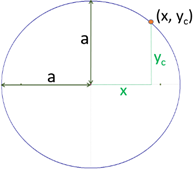
Figure 12 - Transformation Starting with circle
All figures shown as part of the circle to ellipse transformation is displayed on a cartesian plane where the center point is (0, 0).
Start with a circle of radius ‘a’, and some arbitrary point
(x, yc) as seen in Figure 8 - Transformation Starting with circle. Note
that the subscript ‘c’ is used for yc to indicate that this
vertical point is for the point on the circle.

Figure 15 - Rotation Transformation on y axis
The first step in the transformation is to rotate the circle on the
y axis 90° clockwise. The resultant view is of the circle from the
side which appears as a vertical line. Note that the values of a and yc
remain the same.
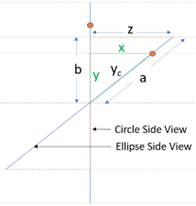
The next step is to rotate the plane of the side view on its x axis (or the z axis) by some arbitrary value. This rotation, if viewed from the left perspective, will be the ellipse.
This last step creates a view where two triangles are superimposed to each other: Triangle with sides ‘abz’, and triangle with sides ‘xyyC ’. These two triangles are similar in that their angles are all the same. Based on the rule of similar triangles, this means that the ratio of any two related segments is also equal. This leads to Equation 7- Similar Triangle Ratios

Equation 8- Similar Triangle Ratios